


Acknowledgment
I want to thank my new Substack friend, Julie West, for her encouragement not to wait until I have finished this work, but to release excerpts as I begin to do so with this post. You can go to her Substack by clicking on her name. She has some great stuff and a book that looks very insightful.
So, here we go.
Introduction
From fall 2018 to the end of 2020, I was deeply engaged in a master’s degree program at Northwest University in Kirkland, Washington. As I navigated my way through this degree program, I discovered one of my true passions: writing. The content of this “mini-book in progress” is a significantly expanded version of my final paper for the course, entitled “Reading the Bible, Exegesis, and Interpretation.”
The professor for this particular course was Dr. Alaine Thomson Buchanan, to whom I also owe much thanks and gratitude for her instruction, insight, and encouragement. In addition to Dr. Buchanan’s academic career, she is an ordained minister with the Assemblies of God (as am I).
“Pick a controversial passage of Scripture.”
Dr. Buhcanan’s instructions to our class for our final exegetical paper were to choose a passage of Scripture, of not more than six verses, that is difficult or even controversial within the Christian Church. Given the controversy surrounding whether a woman should be in the pulpit when men are present, I decided to examine arguably one of the most controversial and anti-women passages in the New Testament, 1 Timothy 2:11-15. This topic has created a vast divide within modern Protestant and Evangelical denominations. Over the last few years, the most notable divide regarding women in ministry has been within the Southern Baptist Convention, which appears poised to split in half at the time of my writing.
Why this title?
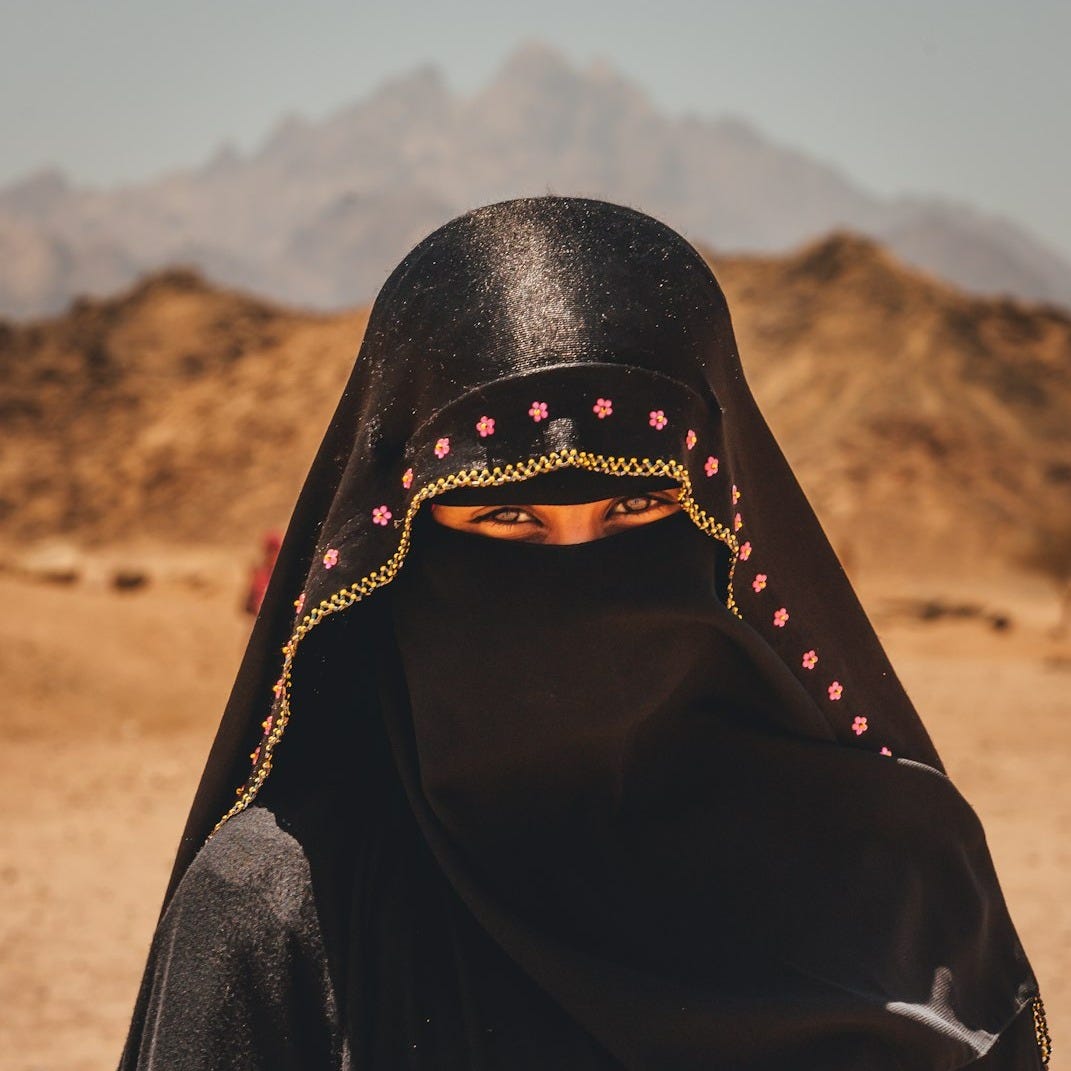
I have chosen a new title from my original course paper, “What’s a Woman To Do?” (listed above), to “The Evangelical Burka.” I believe this title is more descriptive of the adverse effects that an inaccurate interpretation and application of Paul's biblical teaching have upon women in the modern-day Church.
In Islam, women wear a variety of head coverings. The “hijab” covers the hair and may or may not cover the neck while leaving the face fully exposed. The “niqab” is like the hijab except it covers the face while leaving the eyes exposed. The “burka,” however, is the most isolating of all the “coverings” as it features a mesh “screen” over the eyes, essentially cutting the woman off from those around her even while she is present in public.
These three types of Islamic head coverings for Muslim women symbolize the different degrees to which conservative denominations have denied spiritually gifted women from being used in their God-given gifts within the Body of Christ. The “Evangelical Burka,” in my estimation, represents the teaching of the hardliners who demand that women must “be silent” and “not teach with men present.”
Upcoming Epilogue
In the form of an Epilogue, I plan to address another element of this group’s Evangelical Burka that commands wives to remain in the home with a physically abusive (possibly alcoholic) husband. These same churches that silence women in most church ministries also teach that such an abused woman needs to “submit” to her husband until he is saved, regardless of the physical and mental danger she is in. More on that after we cover the role and restrictions of women in ministry.
A Reluctance Within the Evangelical Church
Regarding the role of women in the ministry, the Assemblies of God has been ordaining women since its inception in 1914. However, within the larger body of Christ, many spiritually gifted women of God have experienced various degrees of suppression or outright denial of their demonstrable gifts for edifying the body of Christ through preaching, teaching, and ministering. Professor Buchanan, who is so fluent in Koine Greek that when others bring their NIV or NASB Bibles to Church, she brings her Greek New Testament instead. Still, with her extensive academic work and knowledge of the original language of the New Testament, she has experienced marginalization when lesser-educated men were present. Her perspective was of great help in this project.
Initially, I did not know precisely where I would end up on this issue, but I was excited to begin pursuing the Truth. I hope you enjoy the ride as I have enjoyed the journey. As a side note, I was delighted to find that my final paper received the highest grade possible, and I am grateful for the many compliments I received from fellow students for my presentation to the class.
However, my desire to expand and share this content extends far beyond getting praise or a passing grade; I want to offer a thoughtful, contextual examination to my fellow pastors, denominational leaders, and fellow Christians for their consideration. I believe the words God told Moses to say to Pharaoh apply to a large segment of the modern-day Christian Church: “Let my people (women) go!”
For His Glory,
Pastor Timothy B. White

1. THE FUNDAMENTAL ONGOING DEBATE:
ARE WOMEN FORBIDDEN TO MINISTER TO MEN?
The primary focus of this study is to address the ongoing debate about women in ministry. The general question we will consider is, “Does Paul teach that women are forbidden to engage in the preaching, teaching, and similar pastoral ministry within Jesus’ Church as a recognized credentialed minister whenever men are present?” As one young Calvinist Pastor said to me some years ago, “absolutely not,” and then he read to me Paul’s words in 1 Tim. 2:11-12:
“(11) A woman should learn in quietness and full submission. (12) I do not permit a woman to teach or to have authority over a man;” she must be silent. (NIV84)
For this brother in Christ, those two verses clarified the issue – period. Of course, his belief on this subject extended beyond two verses in the Bible, and on so many other, more critical doctrines, we agree.
Are we overlooking essential contextual elements?
But is it that simple? Could we be missing significant cultural contexts, ignoring the possible conflict of parallel passages, and neglecting crucial exegetical examination of the original language of this text? With approximately two millennia separating Paul’s words from our present-day Christian Church, we owe it to ourselves and the body of Christ to explore these critical elements related to proper biblical interpretation.
Far too many believers recite what they are told the Bible says without actually studying it for themselves. So, I invite you to join me on an “excavation” of the cultural, historical, biblical, and linguistic facets surrounding this issue to see what we uncover.
What about women as a lead pastor?
On the more specific subject of women as the lead Pastor of a congregation, I will discuss this at length after we have done our broader “excavation” on the above question. As a “teaser,” I would say that I believe God has given men the primary role of leader, protector, and guide in society and in the Church of Jesus. While I firmly believe that men, whenever possible, should hold the lead pastoral role in the local Church, that does not preclude situations where a man is not available or qualified, thereby opening the role to a woman minister. More to say on this later.
Disclaimer
I am keenly aware that biblical scholars and seminary professors, far more accomplished than I am, have studied and debated this issue for generations. However, I am also mindful that believers have the same Holy Spirit referred to in 1 John 2:20, 26 as “his anointing (which) teaches you about all things,” and a plethora of Bible Study reference works, Bible dictionaries, Greek and Hebrew Lexicons, and historical books available in print and online, thereby giving the average follower of Christ a chance to investigate these matters themselves.
In humility and openness, I offer the reader my best understanding of Paul’s teaching, based on the cultural and historical contexts of the first century, the original language, and crucial parallel passages in Scripture. Taking a multi-directional approach to this issue, I believe, will give today’s Christian Church the best chance to “rightly divide the Word of Truth” (2 Tim 2:15) and unleash the gifts and callings of God through His servants, both male and female.
“Let the reader understand.”
[Watch for Part 2, “What’s a Woman To Do?” in a week.]
© by Timothy B. White, October 2025, All rights reserved
Thank you for the acknowledgement. Btw, I am AG
It's also very frustrating how faithful women in ministry get automatically lumped in with being politically and theologically liberal; I've seen so many videos of someone showing a woman preaching social "justice" in front of a rainbow flag, and then saying. "See, this is what happens to churches with female pastors!"