


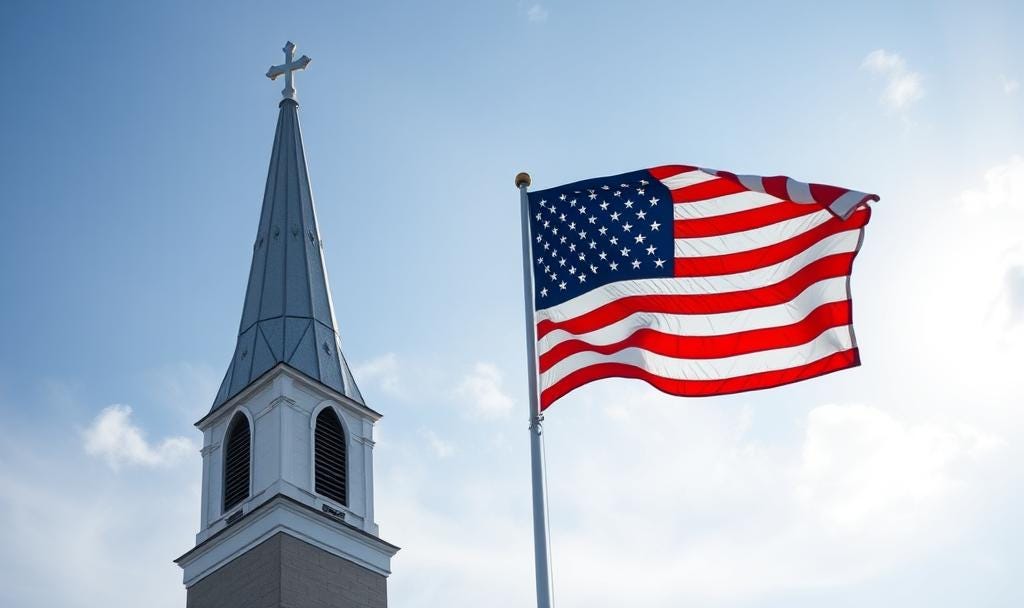
How many times, as a culturally engaged pastor, have I heard this question: “How can a Church be participating in politics? Is your Church tax-exempt?” What prompted this question was a post I placed on a local social media site announcing that residents could sign an initiative at our church if they so desired. The focus of the initiative was to protect Washingtonians’ right to have natural gas in their homes. Yes, our liberal state government has worked overtime to eliminate natural gas from all new home construction because of the myth of climate change. Almost everyone was appreciative and encouraged others to sign it.
Since that online encounter, the IRS has decided that Churches can endorse political candidates and issues without the threat of losing their tax-exempt status. As reported in, of all places, the New York Times, in part stated:
The agency said that if a house of worship endorsed a candidate to its congregants, the I.R.S. would view that not as campaigning but as a private matter, like “a family discussion concerning candidates.”
For the full article, click here.
(For a deeper dive into the fallacy of “Separation of Church and State,” I will be posting another column I wrote on that specific topic to my Substack shortly.)
“No Creator, No Rights”
July 4th, this year, was the 249th anniversary of the Declaration of Independence, often called our nation’s birth certificate. My question for our consideration is whether this sacred document is solely political or something more.
On that question, Gary DeMar, President of American Vision, states:
“The Declaration of Independence is a religious document, basing its argument for rights on theological grounds. Rights, the Declaration maintains, are a gift from the Creator: ‘We are endowed by our creator with certain inalienable [unchangeable, absolute, immutable] rights.’ The logic is simple. No Creator, no rights.”
As DeMar said, “The logic is simple. No Creator, No Rights.” Our founding fathers’ understanding of human civilization and how it should be viewed begins with and is founded upon the belief in a divine Creator as taught in the Scriptures. In other words, we cannot separate the church from the state because we would not have the “state” (our nation) if it were not for the Church.
The State’s Relationship to the Church
A couple of years ago, the then mayor of New York City made a statement I have quoted before that was quite profound and surprising from a liberal Democrat. He was in a news conference discussing the increasing crime in the city, and then he stunned almost everyone with these statements:
“…And we say over and over again, "We need to build a world that's better for our children." No, we need to build children that's better for our world. And we have to be honest about that.
And it means instilling in them some level of faith and belief. ... Don't tell me about no separation of church and state. State is the body. Church is the heart. You take the heart out of the body, the body dies. I can't separate my belief because I'm an elected official. When I walk, I walk with God. When I talk, I talk with God. When I put policies in place, I put them in with a God-like approach to them. That's who I am.
For the full transcript of his speech, click here.
Colonial Pulpits and the Declaration of Independence
Most Americans would be surprised to learn that portions of the Declaration of Independence contain complete sentences – word for word – from the numerous sermons preached and published for the public to read from the early 1600s to 1763.
Probably the most influential pastor of the actual wording within our Declaration of Independence – including almost exact quotes – was from pastor John Wise’s teachings. His sermons and writings powerfully expounded on the biblical basis for the issues that eventually found their way into this foundational document.
In 1864, historian Benjamin Morris stated that “some of the most glittering sentences in the immortal Declaration of Independence are almost literal quotations from [an] essay of John Wise,” which was “used as a political textbook in the great struggle for freedom.”
Imagine that - the sermons preached from colonial pulpits became the blueprint for the U.S. Constitution and the most powerful, blessed, and free nation on the face of the earth. We must ask ourselves, preachers, is the content of our messages capable of instructing a community or region in how to create or restore a free, safe, secure, and prosperous society? If not, why not?
Sixty-two years later, on the 150th anniversary of the Declaration of Independence, President Calvin Coolidge, in a speech he delivered in Philadelphia in 1926, stated: “The thoughts in the Declaration can very largely be traced back to what [Pastor] John Wise was writing in 1710.”
Indebted to Colonial Ministers and American Christianity
One historian put it this way:
“It is without question: American Christianity, …was primarily responsible for the philosophy expressed in the Declaration of Independence – a philosophy that energized men to love freedom, that made them see themselves as heirs of human dignity and subject to a law higher than the state (i.e., Nation).”
David Barton, the founder of Wall Builders, said that many Americans today are sadly unaware of this fact: “Ministers were intimately involved in every aspect of introducing, defining, and securing America’s civil and religious liberties.”
The point is this: It was colonial Christian pastors whose sermons “laid the intellectual basis for American Independence.”
Thomas Jefferson said of the sermons of his day, “Pulpit oratory ran like a shock of electricity through the whole colony.”
Essential Questions for Today’s Pastors to Consider
Maybe we who preach and teach the Bible should ask ourselves: “What impact do our sermons have on this generation, the culture, or the ideologies vying for societal superiority?” In our larger work of “rightly dividing the Word of Truth” (2 Tim. 2:15b), does our work include holding up the hot topics of our day to the “plumbline” of that Word? How effectively are we shining the light of Truth onto the issues that accost our congregants’ eyes and ears outside the walls of our churches?
And - not to stop there - but to honestly assess whether we, as preachers and teachers, have purposely avoided controversial topics out of fear of losing members, or upsetting some? Does the possibility of being labeled a “Christian Nationalist” intimidate you into self-censorship? The most common form of bringing politics into the pulpit is when the pastor purposely avoids or sugarcoats controversial topics because he fears how people will react. The Bible says that “the fear of man will [always] prove to be a snare” (Prov. 29:25a), and the maturity and influence of the body of Christ is seriously reduced.
To Be Relevant, We Cannot Be Neutral.
Furthermore, not addressing current issues and prominent leaders in light of scripture gives the impression that the Bible and Christianity only apply within the confines of the local church and faith in God. The unintended consequence is that young believers and our youth may get the idea that the “real world” is disconnected from Christianity, and question the latter’s relevance for today.
On the contrary, our American Christian heritage regarding the pulpit is quite different from what we see today.
Wayne C. Sedlak, a historian and a pastor, explains,
“The pulpits of that era (17th and 18th centuries) were anything but neutral. And they certainly did not subscribe to that error of reasoning so dominant in the churches today, which says that the only proper subject of concern for the pulpit pertains to individual salvation and one’s personal preparation for heaven.”
Listen to our 2nd President, John Adams, response to the pastors of his day when he happily said, “the pulpits thunder and lightning every Sabbath against King George’s despotism” and praised these pastors as being among “the most conspicuous, the most ardent, and the most influential” men of that day in the “awakening and revival of American principles and feelings” that led to our ultimate Independence [“The Works of John Adams,” Charles Adams, editor].
One historian, Tom Barrett, observed, “I do not consider it a stretch at all to say that were it not for the pastors and churches of colonial America, our land would be a British colony today” [Source: “The Forgotten Holiday”].
Maybe we, who preach and teach other believers, should reread the paragraphs above.
Our Nation Needs a Patriotic and Bold Clergy
Where would we be today had our founding fathers not been willing to pledge their lives, fortunes, and sacred honors? What kind of people would they have been in the latter portion of the 18th century had the pulpits been more concerned about keeping people in the pews with self-help and prosperity-laden sermons instead of boldly addressing issues that included politics, morality, and government corruption, as well as sin and salvation? I shudder to wonder.
On May 9, 1789, in an article titled “The Importance of the Protestant Religion Politically Considered,” which appeared in the Washington, D.C., newspaper “Gazette of the United States,” we find this glowing endorsement of these brave pastors:
“Our truly patriotic clergy boldly and zealously stepped forth and bravely stood [as] our distinguished sentinels to watch and warn us against approaching danger; they wisely saw that our religious and civil liberties were inseparably connected and therefore warmly excited and animated the people resolutely to oppose and repel every hostile invader. May the virtue, zeal, and patriotism of our clergy be ever particularly remembered…they wisely saw that our religious and civil liberties were inseparably connected.”
How is it possible that we, the Christian Church, cannot see that connection, too?
As mature followers of Christ, we can simultaneously love God and our Nation without losing our perspective or having misguided priorities. In rebuttal of that statement, some will wrongly apply Jesus’ warning in the Sermon on the Mount, saying, “You cannot serve two masters.” Such a reply is an excuse to hide from speaking out on issues that could bring disagreement, opposition, and loss of members.
“Preach…For the time will come…”
As the final words of the Apostle Paul to Timothy stated:
“Preach the Word; be prepared in season and out of season; correct, rebuke, and encourage - with great patience and careful instruction. For a time will come when people will not put up with sound doctrine. Instead, to suit their own desires, they will gather around them a great number of teachers to say what their itching ears want to hear.” (2 Tim. 4:2-3)
When we, the preachers, teachers, and church leaders of today, make the choice to do our work solely before an audience of One, to please only Him, then the fear of man and the rejection of a corrupt society will fade away. And then, with the Church led in this way, only the LORD knows the depth, breadth, and length that His Church could impact and influence the generations to come.
For those interested, on Sunday, June 30, 2024, I preached on this subject with much more content, which you can listen to on our podcast: Proclaim Liberty Throughout the Land (sermon title).
[Other Sources, including direct quotes from: “The Black Robe Regiment: The Pastor-Patriots of the Revolution,” Wineskins.org; “The American Revolution Actually Began in the Pulpits,” By Gary Palmer, Special to the Press-Register; David Barton’s ministry, “Wall Builders;” Other sources cited within the above text.]
NOTE: This is an expanded version of my original column by the same name in the July 2024 edition of the Stevens County Times, Pastor’s Perspective Column, based out of Loon Lake, WA. 99148.
© By Pastor Timothy B. White, all rights reserved.